Bitcoin SEO Lab · informational
What is the mempool? Bitcoin's waiting room explained
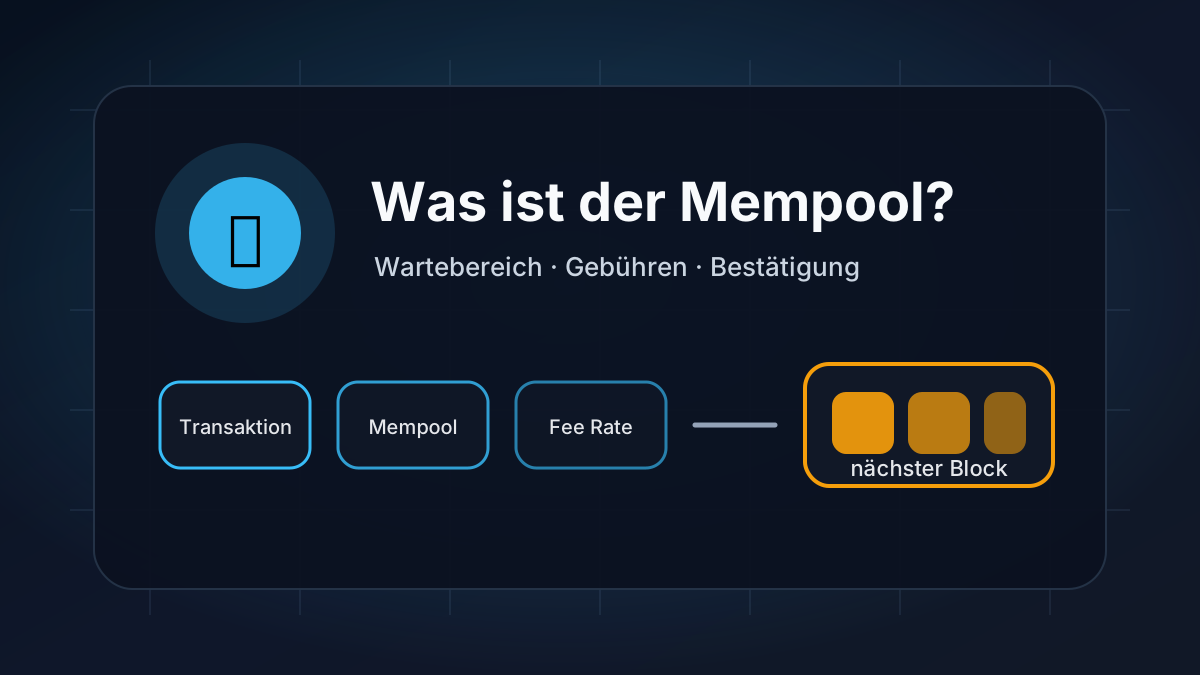
The mempool is the waiting area for Bitcoin transactions that are already known to the network but have not yet been confirmed in a block. When you send Bitcoin, the transaction is not final immediately. Nodes check it, pass it on, and it waits until miners include it in a block.
For beginners, the mempool explains why a Bitcoin transaction can sometimes confirm quickly and sometimes wait longer. It also helps explain why Bitcoin transaction fees change.
The short answer
The mempool is:
- not one central storage place,
- the local waiting area of individual Bitcoin nodes,
- filled with valid but unconfirmed transactions,
- a signal of demand for block space,
- and one reason fees rise when the network is busy.
What happens when you send Bitcoin?
A wallet creates a transaction and signs it with the matching private keys. The transaction is then broadcast to the Bitcoin network. Nodes check basic rules: Are the inputs valid? Has the same output already been spent? Is the signature correct? Is the transaction acceptable under network policy?
If a node accepts the transaction, it can forward it to other nodes and keep it in its mempool. Miners can choose it when they build a new block, which is secured through proof of work. For a broader overview, read What is Bitcoin?.
If you came here because of fees
The mempool explains why some payments have to wait. If you mainly want to understand why fees change and what wallet fee suggestions mean, also read Bitcoin transaction fees explained.
Why is there not one single mempool?
People often talk about “the mempool” as if it were one central queue. Technically, every Bitcoin node has its own mempool. These mempools are usually similar, but not always identical.
Reasons include:
- nodes receive transactions at different times,
- nodes can have different memory limits,
- some transactions may be rejected by some nodes,
- restarts or connection problems can create local differences.
For everyday use, the simple mental model is enough: the mempool shows which valid transactions are waiting for confirmation.
Why do transactions wait?
Bitcoin blocks have limited space. Not every waiting transaction fits into the next block. When few transactions are waiting, a low-fee payment can confirm quickly. When many transactions compete, miners usually choose the most attractive fee rates first.
The priority does not depend on the fiat amount sent. A small payment can be technically large if it uses many inputs. What matters is the fee per virtual byte, often shown as sat/vB.
How are mempool and fees connected?
The mempool makes demand for block space visible. When many transactions wait, there is competition for the next block. Wallets estimate which fee rate may be needed for confirmation within a desired time range.
That does not mean the highest fee is always best. For non-urgent payments, a lower fee may be enough. For urgent payments, too low a fee can leave the transaction unconfirmed for a long time.
What does “unconfirmed” mean?
An unconfirmed transaction is known to the network but not yet included in a block. It is not final in the blockchain. Recipients may see it in a wallet. Tiny low-risk payments may be treated differently in some contexts, but larger or riskier transfers normally need confirmations before they are considered reliable.
Can a transaction disappear from the mempool?
Yes. An unconfirmed transaction can be removed from local mempools if it stays unconfirmed for a long time, if nodes free memory, or if it is replaced by another valid transaction. That does not automatically mean money has disappeared. Often the coins can be spent again, depending on the wallet and situation.
Beginners should avoid panic. First check what the wallet says, whether RBF is enabled, and whether a reputable block or mempool explorer knows the transaction.
RBF and CPFP in brief
- RBF (Replace-by-Fee): An unconfirmed transaction can be replaced by a new version with a higher fee if it signaled RBF and the wallet supports it.
- CPFP (Child Pays For Parent): A later transaction pays a high fee so miners include both transactions together.
Both can help, but they are not always available and should not be used carelessly.
How to check the mempool sensibly
For learning, a mempool explorer can show:
- roughly how many transactions are waiting,
- which fee rates are commonly being confirmed,
- whether a specific transaction is known,
- where it sits in the current fee market,
- whether it has been confirmed.
Use this as orientation, not as the only decision source. Wallets, explorers and nodes can show different information or delays.
What a mempool explorer cannot guarantee
A mempool explorer shows a snapshot from one service or node. Other nodes may see transactions earlier, later or temporarily not at all. Fee estimates are not guarantees for a specific confirmation time. Never enter a seed phrase or private key into a website because a transaction is waiting.
Common beginner mistakes
Choosing too low a fee when time matters
If a payment must confirm quickly, a very low fee rate can be a problem. The transaction may remain in the mempool for a long time when network demand rises.
Confusing exchange withdrawals and on-chain fees
An exchange or service provider can have its own withdrawal rules. The displayed fee is not always identical to the actual Bitcoin network fee.
Treating mempool estimates as guarantees
Explorers and fee estimates are snapshots. The mempool can change quickly. A prediction such as “next block” is not a guarantee.
Ignoring wallet security
Fee knowledge does not help if the wallet is unsafe. Anyone self-custodying Bitcoin should also understand how a Bitcoin wallet manages keys and why seed phrases matter.
Frequently asked questions
Is the mempool part of the blockchain?
No. The mempool contains unconfirmed transactions. A transaction becomes part of the blockchain only when it is included in a valid block.
Does every transaction automatically get a confirmation?
No. A transaction must first be included in a block. Then it has one confirmation. Each additional block adds another confirmation.
Why does my wallet show “pending”?
Usually it means the transaction is known but not yet confirmed. The cause may be a low fee rate, high demand, or a cautious wallet display.
Can I cancel a waiting transaction?
Not like a bank transfer. Depending on the wallet, RBF signal, and network state, a replacement transaction may be possible. Never give a seed phrase or private key to a website claiming to fix it.
Conclusion
The mempool is the waiting area between sending a Bitcoin transaction and its inclusion in a block. Understanding it helps users think more realistically about fees, waiting times, and unconfirmed transactions.